miércoles, 9 de marzo de 2011

Unit 11, Ancient Rome

1. True or false? Correct false sentences.

  1. Between 1st and 2nd centuries AD Rome conquered all the territories on the Italian Peninsula.
  2. Between 500 and 250 BC, Roman Empire expanded north to south from British Isles to the Sahara Desert, and east to west from Mesopotamia to the Iberian Peninsula.
  3. The Roman Empire was divided in provinces that had to pay taxes to Rome. Each province was controlled by a governor.
  4. During the Monarchy the king was helped by the senate.
  5. The last king of Rome, Tarquin the Proud, was Etruscan and was dethroned in 509 BC.
  6. The two main institutions of the Republic were the comitias and the senate.
  7. The plebeians were non-citizens who obtained their citizenship by the 4th century BC.
  8. During the Empire, Rome had to fight against Carthage in the Punic Wars to extend its power around the Mediterranean.
  9. In the 1st century BC the Republic was weakend by corruption and internal conflicts.
  10. The fist triumvirate was formed by Mark Antony, Julius Caesar and Crassus; the second triumvirate was formed by Pompey, Octavian and Lepidus.
  11. In 27 BC Octavian became Augustus and the Roman Empire started.
  12. The military anarchy was a fifty years period in which there were more than 25 emperors.
  13. In the 3rd century BC Roman army was defeated by Persians and Barbarians.
  14. During the 4th century AD emperors Diocletian and Constantine improved the situation of the empire.
  15. When the Huns entered Germanic territories, Barbarians had to flee into the roman empire and Romans couldn't stop this invasion.
  16. Emperor Constantine divided the empire into the Western Roman Empire and the Eastern Roman Empire.
  17. The Western Roman Empire had its capital in Constantinople and the Eastern Roman Empire in Rome.
  18. The Eastern Roman Empire was brought to an end thousand years later than the Western Roman Empire and changed its name to the Byzantine Empire.
  19. Emperor Constantine declared Christianity the only religion of the Roman Empire.
  20. Christians were persecuted by the empire because they didn't want to worship Jupiter and the other Roman gods.
Key:


  1.  False: Between 500 and 250 BC/ During the Republic Rome conquered all the territories on the Italian Peninsula.
  2. False: Between 1st and 2nd centuries AD, Roman Empire expanded north to south from British Isles to the Sahara Desert, and east to west from Mesopotamia to the Iberian Peninsula.
  3. True.
  4. True.
  5. True.
  6. False: The three main institutions of the Republic were the comitias, the magistratus and the senate.
  7. False: The plebeians were citizens who obtained their political rights (being magistrates and senators) by the 4th century BC.
  8. False: During the Republic, Rome had to fight against Carthage in the Punic Wars to extend its power around the Mediterranean.
  9. True.
  10. False: The fist triumvirate was formed by Pompey, Julius Caesar and Crassus; the second triumvirate was formed by Mark Antony, Octavian and Lepidus.
  11. True.
  12. True.
  13. False: In the 3rd century AD Roman army was defeated by Persians and Barbarians.
  14. True.
  15. True.
  16. False: Emperor Theodosius divided the empire into the Western Roman Empire and the Eastern Roman Empire.
  17. False: The Western Roman Empire had its capital in Rome and the Eastern Roman Empire in Constantinople.
  18. True
  19. False: Emperor Theodosius declared Christianity the only religion of the Roman Empire.
  20. False: Christians were persecuted by the empire because they didn't want to worship the emperor. 

miércoles, 2 de marzo de 2011

Unit 11, Ancient Rome

This is a useful revision for the exam. Key is beneath the activities.


1. Order the following events from the oldest to the most recent:

First triumvirate
Lucius Tarquinus Superbus is dethroned
Persians attack from the east
Founding of Rome
Fall of the Western Roman Empire
Diocletian comes to power
Punic Wars
Constantine tolerates Christianity
Huns enter Germanic territory
Plebeians fight and obtain the “tribune of the plebeians”
Rome is conquered by the Etruscans
Second triumvirate
Germanic tribes form their own kingdoms in the roman Empire’s territories
Plebeians can be magistrates and senators
Theodosius divided the empire into two
The Republic starts


2. Match the following dates to their events:

1)      753 BC                              a)  Julius Caesar was assassinated
2)      509 BC                              b)  Edict of Milan: Christianity is allowed
3)      44 BC                                c)  Founding of Rome
4)      27 BC                                d)  Fall of the Roman empire   
5)      212 AD                              e)  Christianity is the official religion of the Empire                  
6)      313 AD                              f)  Huns entered the Germanic territories 
7)      375 AD                              g)  The Republic started
8)      380 AD                              h)  The Empire started
9)      395 AD                              i)  Edict of Caracalla
10)  476 AD                              j)  The Roman empire is divided into two


Key, activity 1:

1_Founding of Rome
2_Rome is conquered by the Etruscans
3_Lucius Tarquinus Superbus is dethroned
4_The Republic starts
5_Plebeians fight and obtain the “tibune of the plebeians”
6_Plebeians can be magistrates and senators
7_Punic Wars
8_First triumvirate
9_Second triumvirate
10_Persians attack from the east
11_Diocletian comes to power
12_Constantine tolerates Christianity
13_Huns enter Germanic territory
14_Germanic tribes form their own kingdoms in the roman Empire’s territories
15_Theodosius divided the empire into two
16_Fall of the Western Roman Empire


Key, activity 2:
1)-c), 2)-g), 3)-a), 4)-h), 5)-i), 6)-b), 7)-f), 8)-e), 9)-j), 10)-d).

viernes, 18 de febrero de 2011

Octavian -Augustus: the first Roman emperor

Activities for your notebook:
  1. In which battles were Caesar's murderers defeated?
  2. Who was the first emperor of the Roman Empire?
  3. Which two leaders were involved in the third civil war?
  4. Which battle ended the third civil war?
  5. What is the "Res Gestae Divi Augusti"?
  6. What does "Pax Romana" mean?
  7. Who succeeded Augustus as emperor?
  8. Why was Octavian given the title "Augustus"?
  9. What was the significance of the Battle of Actium?
  10. Which two rivers formed the furthermost boundary of the Roman Empire in Europe during the reign of Augustus?

jueves, 3 de febrero de 2011

Unit 10. True or False test (pages 114-121)

a)      The Classical period was a peaceful time in Ancient Greece.
b)      Before the Classical period Persians expanded their territories creating a huge empire.
c)      The Persian Wars began when Persians tried to conquer the Greek poleis in Asia Minor.
d)      The First Persian War was won by Persia and the Second one by the Greeks.
e)      After the Persian Wars Athens turned into the wealthiest and most important polis.
f)        Athenian domination after the Persian Wars was seen as a threat to Sparta and other poleis.
g)      Peloponnesian War was a civil war that lasted more than 25 years and ended when Athens won it.
h)      After the Peloponnesian War the poleis were so weak that Macedonian kings could conquer them easily.
i)        Thanks to Alexander the Great’s conquests Greek culture spread towards the east.
j)        The Hellenism is a fusion of Greek and Oriental cultures; the art of this period is called “Hellenistic”.
k)      Alexander’s sons divided up the territory when he died and founded different kingdoms called Hellenistic monarchies.
l)        The majority of population in Greece were citizens.
m)    Non-citizens were foreigners, slaves and women.
n)      Rich women were supposed not to go out home but poor ones had to work out of home as peasants, nannies or shopkeeper.
o)      Citizens used to work in trade and crafts.
p)      All the citizens were very wealthy people; foreigners were poor.
q)      Long distance trade and local commerce were important economic activities in Greece.
r)       A hero in Ancient Greece was a son of a god and a human.
s)       Girls could be priests (so called priestesses) in Ancient Greece.
t)        The minotaur was a horse with a human head, chest and arms.
u)      Priests and priestesses were the gods’ servants.
v)      Greeks are considered to be fathers of philosophy and science because they used myths to explain the world.

domingo, 9 de enero de 2011

Unit 10 "True or false"

Eastern Mediterranean civilizations.
  1. The Minoan civilization developed on the island of Crete. True
  2. Cretan and Phoenician civilizations were ruled by kings. True
  3. The Hebrews were ruled by nomadic shepherds when they settled in Canaan. False, the Hebrews were ruled by kings when they settled in Canaan or The Hebrews were nomadic shepherds that settled in Canaan.
  4. Maritime commerce was poorly developed in Crete because the island hasn't a strategic position on sea routes. False, Maritime commerce was highly developed in Crete because the island hasn't a strategic position on sea routes.
  5. To have a strategic position on sea routes means to be in a good place on sea routes. True
  6. Cretans didn't have a written language, so they belong to Prehistory. False, Cretans had a written language, so they belong to History.
  7. Phoenicians were organised in city-states. True
  8. A city-state is a big empire with several important cities. False, A city-state is a state that comprises only a city with its own govermente, laws, army and way of life.
  9. Cretans and Phoenicians were monotheistic and Hebrews polytheistic. False, Hebrews were monotheistic and Cretans and Phoenicians polytheistic.
  10. Hebrews invented a phonetic alphabet. False, Phoenicians invented a phonetic alphabet.
  11. Cretan and Phoenician economy was based on agriculture and cattle raising. False, Cretan and Phoenician economy was based on maritime commerce.
  12. The Phoenician civilization developed in the Palestinian region of Canaan. False, The Hebrew kingdom developed in the Palestinian region of Canaan or The Phoenician civilization developed on a narrow fringe of the eastern Mediterranean region.
  13. Phoenicians had several colonies on the coast, such as Cadiz/Gadir. True
  14. Knossos Palace, from Crete,  was decorated with paintings. True
  15. The Roman Empire  conquered the Phoenician city-states and the Hebrews' kingdom. True
Origins of Greek civilization.
  1. Greek civilization was located in Turkey, south of Balkan Peninsula and Asia Minor. False, Greek civilization was located in the south of Balkan Peninsula, the coast of Asia Minor and on many islands in the Eastern Mediterranean sea.
  2. Ancient Greece was an unified country. False, Ancient Greece never was an unified country because its physical characteristics. 
  3. The physical characteristics of Ancient Greece are: flat relief and big valleys for cultivating. False, The physical characteristics of Ancient Greece are: high relief and small valleys for cultivating.
  4.  Every valley and each island of  Ancient Greece was an independent state. True
  5. A different language was spoken in every valley of Ancient Greece. False, The same language, Greek,  was spoken in every valley of Ancient Greece.
  6. People in Ancient Greece worshipped the same gods although they lived in different states. True
  7. Greeks obtained most of their food from the Mediterranean sea. True
  8. Cretans are part of Ancient Greece. True
  9. Greeks used the Mediterranean sea only for fishing. False, Greeks used the Mediterranean sea for fishing, trade and navigation.
  10. The different periods of Ancient Greece are: Minoan civilization, Dark Age, Archaic Period and Hellenistic Age. False, The different periods of Ancient Greece are: Minoan civilization, Mycenaean civilization, Dark Age, Archaic Period, Classical Period and Hellenistic Age.
  11. Agamemnon was a historical king of Mycenae. False, Agamemnon was a legendary king of Mycenae.


City-states.
  1. In Early Greece city-sates were called polis. True
  2. Aristoi is a Greek word that means “government”. False, Aristoi is a Greek word that means “the best”.
  3. In same poleis aristocracy replaced democracy. False, In same poleis democracy replaced aristocracy.
  4. An “acropolis” is a citadel on a hill. True
  5. Athens is a famous example of aristocratic government and Sparta of democratic government. False, Athens is a famous example of democratic government and Sparta of  aristocratic government.
  6. Assemblies and councils were necessary in a democratic government. True

Greek expansion.
  1. Many Greeks migrated between the 8th and 6th centuries because the population increased and there was not enough food for everyone. True
  2. In early Greece land was divided equally. False, In early Greece land was divided unequally because rich people owned most of the land.
  3. In early Greece the land was very fertile because of the flat relief. False, In early Greece the land was not fertile because of the high relief. 
  4. Many Greeks migrated to the north and the south of the Balkan Peninsula. False, Many Greeks migrated to the east and the west of the Balkan Peninsula.
  5. Greek colonies were founded in places near the coast in order to fish. False, Greek colonies were founded in places near the coast in order to make transport and trade easier.
  6. Greek colonies weren’t independent. False, Greek colonies were independent wether they had the same beliefs, traditions and organisation as the polis they came from.
  7. Colonization spread Greek influence beyond its frontiers. True
  8. The Greeks founded colonies on the east coast of the Iberian Peninsula. True


martes, 12 de octubre de 2010

Palaeolithic art

(Adapted from wikipedia for ESO)
Palaeolithic art was produced from about 32,000 to 11,000 years ago. There are two categories: Parietal or Cave Art and Mobiliary or Portable Art.

PARIETAL OR CAVE ART
  • Cave art or cave paintings are paintings on cave walls and ceilings. The purpose of the palaeolithic cave paintings is not known. The evidence suggests that they were not merely decorations of living areas, since the caves in which they have been found do not have signs of ongoing habitation. Also, they are often in areas of caves that are not easily accessed. Some theories hold that they may have been a way of communicating with others, while other theories ascribe them a religious or ceremonial purpose.

The most common themes in cave paintings are large wild animals, such as:

Bison

(Bison from Altamira cave, Santillana del Mar, Spain)

Horses
(from Lascaux cave, Dordogne, France)

Deer
(female deer from Altamira cave, Santillana del Mar, Spain)

Aurochs

(from Lascaux cave, Dordogne, France)

But also there were tracings of human hands:
(From El Castillo cave, Puente Viesgo, Spain)

Or abstract patterns:
 (From El Castillo cave, Puente Viesgo, S,pain)

And fingers flutings (lines that fingers leave on a soft surface)
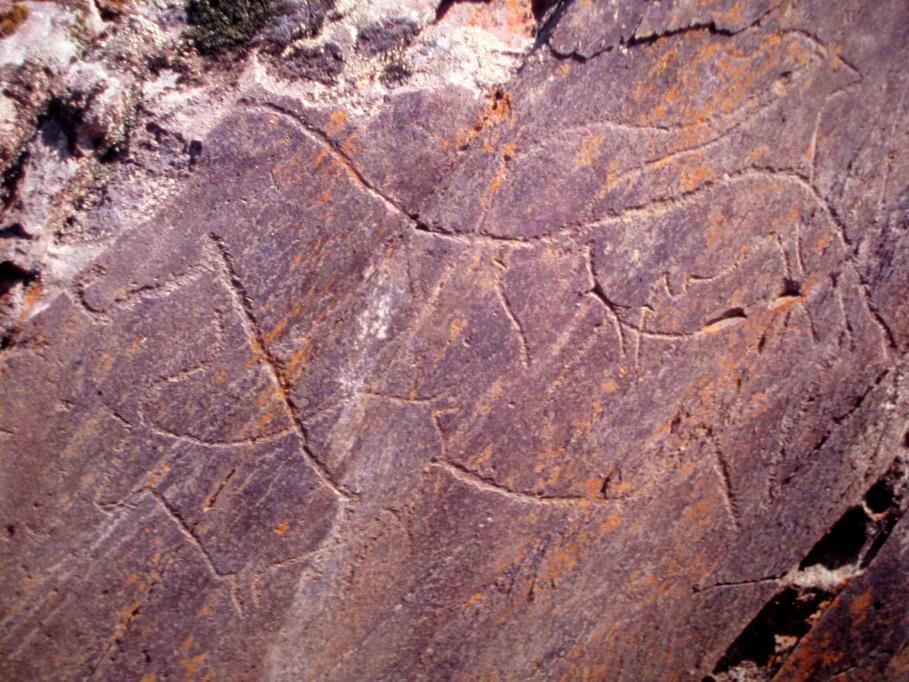
  • Rock engravings: they were made with a burin (a lithic flake with a chisel-like edge which prehistoric humans may have used for engraving or for carving wood or bone.)
 (Animal engravings from Coa Valley, Portugal. Photo from wikipedia)

  • Bas-reliefs:  sculptures carved on a surface so that they stand out fron the background. They occur in cave entrances or rock shelters for they are sites lit by daylight.
(Aurochs from Fourneau-du-Diable, BourdeiIles, France)

 (Wall reliefs at Roc-aux-Sorcier rock shelter, Vienne, France)

MOBILIARY OR PORTABLE ART 

Portable Art pieces are small mobile objects that could be carried from place to place; this kind of art consists of objects carved from stone, bone, ivory  or antler, and they take a wide variety of forms.
  • Engraved pieces
Engraved stone
 (Hind from Parapalló Cave, Gandía, Spain)

Engraved ivory
 (Mammoth from La Madeleine cave, Dordogne, France. Photo from H. Delporte, Don's Maps)

Engraved bone
(Horses fron El Pendo Cave, Escobedo de Camargo, Spain)
  • Carved pieces
Carved antler
 (Bison from La Madeleine cave, Dordogne, France)
Carved ivory 
(Horse fron Grotte des Espelugues, Lourdes, France) 

Carved bone
(From Enlène cave, Ariége, France )
  • Venus figurines: prehistoric small statuettes of women (4-22cm height) portrayed with similar physical attributes (certain parts of the human anatomy are exaggerated, such as abdomen, hips, breasts and thighs meanwhile other anatomical details are neglected or absent, especially arms and feet). These figurines were carved from soft stone, bone or ivory, or formed of clay and fired. 
(Venus of Grimaldi)
(Venus of Lespugne)
(Venus of Willendorf )


domingo, 3 de octubre de 2010

Palaeolithic tools

This is a summary of an entry from Wikipedia; it has been adapted to ESO.

Lower Palaeolithic

The earliest stone tools in human history are characterised by their simple construction, predominantly comprising of core forms. These cores were rocks that had been struck repeatedly to whittle flakes away, forming a sharp tip:


Eventually, more complex tools began to be developed; these were characterised not by the core, but by the biface. The most notable form of which was the hand axe:

Middle Palaeolithic

In Europe, these bifaces evolved to produce smaller and sharper knife-like tools as well as scrapers:
                                          (picture from www.artehistoria.jcyl.es)

Upper Palaeolithic

At this time, long blades (rather than flakes) appeared:


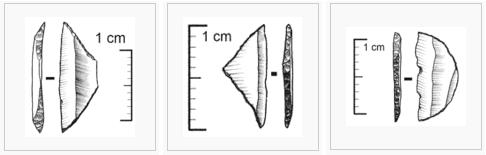
By the end of the Upper Palaeolithic microliths appeared; they were small stone tools (one centimetre long and half a centimetre wide), sufficiently worked so as to be distinguishable from workshop waste or accidents. Regardless of type, microliths were used to form the points of hunting weapons such as spears and (in later periods) arrows and other composite tools.


(Click yellow links for further information and photos)